H2Integrate - Holistic Hybrids Optimization and Design Tool#





H2Integrate (H2I) is an open-source Python package for hybrid systems engineering design and technoeconomic analysis. It models and optimizes hybrid energy plants that produce electricity, hydrogen, ammonia, steel, and other products, using high-resolution location-specific resource data to perform optimization and scenario analysis.
Browse the example workflows in the GitHub repository: NatLabRockies/H2Integrate
What is H2Integrate?#
H2Integrate is designed to be flexible and extensible, allowing users to create their own components and models for various hybrid systems. The tool currently includes renewable energy generation (land-based wind, offshore wind, solar PV, wave, tidal), conventional generation (natural gas combined cycle, combustion turbines, grid electricity), hydrogen production (PEM electrolysis, NG-SMR), energy storage (Li-ion batteries, long-duration energy storage, pumped storage hydropower), fuel cells, and industrial processes (ammonia synthesis, iron ore reduction, steel production, methanol, and more). Other elements can also be included as developed by users. H2Integrate is continually expanding to serve additional hybrid applications -- if you're interested in seeing what's being actively developed, please see the current pull requests in the GitHub repository. Some modeling capabilities in H2Integrate are provided by integrating existing tools, such as HOPP, PySAM, ORBIT, and ProFAST. The H2Integrate tool is built on top of NASA's OpenMDAO framework, which provides a powerful and flexible environment for modeling and optimization.
Note
H2Integrate was previously known as GreenHEART. The name was updated to H2Integrate to better reflect its expanded capabilities and focus on integrated energy systems.
How does H2Integrate work?#
H2Integrate typically models energy systems on a yearly basis using hourly timesteps (i.e., 8760 operational data points across a year). Results from these simulations are then processed across the project's lifecycle to provide insights into the system's performance, costs, and financial viability. Depending on the models used and the size of the system, H2Integrate can simulate systems ranging from the kW to GW scale in seconds on a personal computer. Additionally, H2Integrate tracks the flow of electricity, molecules (e.g., hydrogen, ammonia, methanol), and other products (e.g., steel) between different technologies in the energy system.
Note
Some models are now able to operate with non-hourly time steps. Appropriate time step bounds are included as class attributes when non-hourly time steps are permitted. Check individual model docs and definitions for time step bounds for individual models. All models in a given simulation must be compatible with the specified time step.
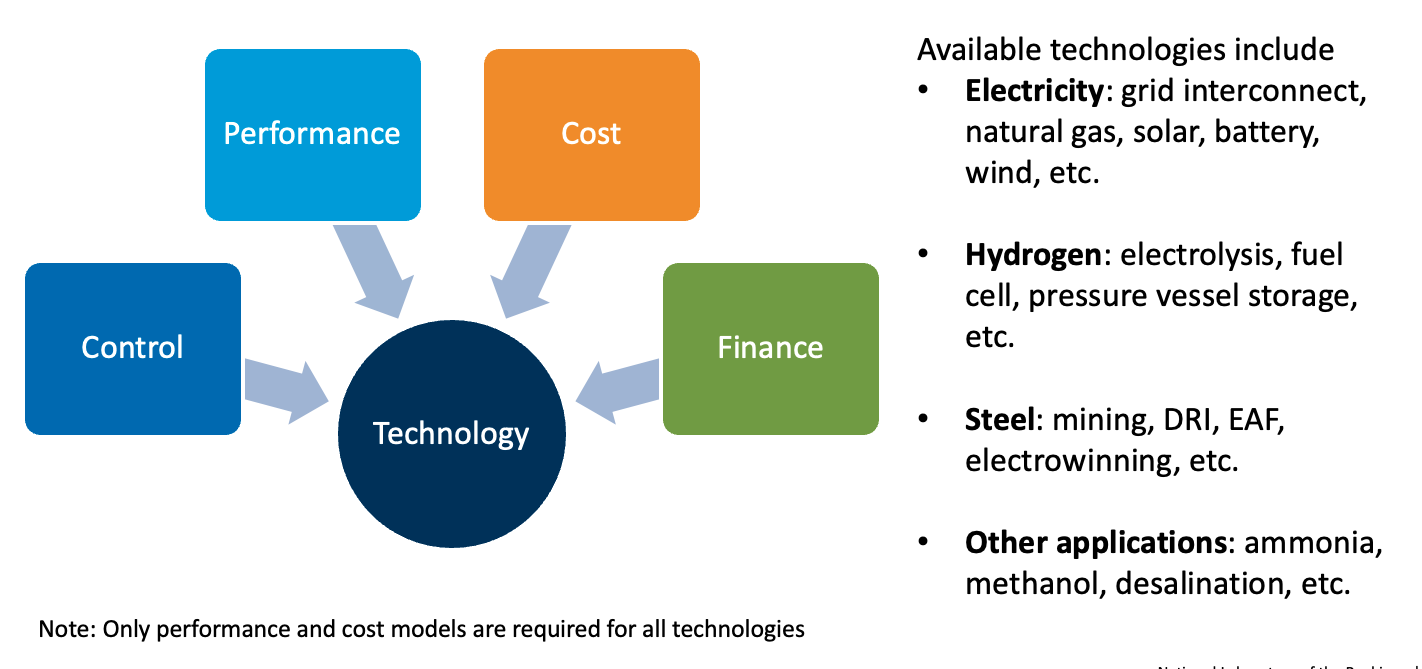
For each technology there are 4 different types of models: control, performance, cost, and finance. These model categories allow for modular pieces to be brought in or re-used throughout H2Integrate, as well as ease of development and organization. Note that the only required models for a technology are performance and cost, while control and finance are optional. The figure below shows these four categories and some of the technologies included in H2Integrate. For a full list of models available, please see Model Overview.
The individual technology models are then connected to create the hybrid system model, as shown in the simplistic example below. Here, data from the performance, cost, and finance models of the grid and battery technologies feed into the overall system performance and finance calculations. There is also a physical connection between the grid and battery performance models in the form of an electrical cable. Lastly, within the battery technology, the control model and performance models are connected for dispatching of electricity.
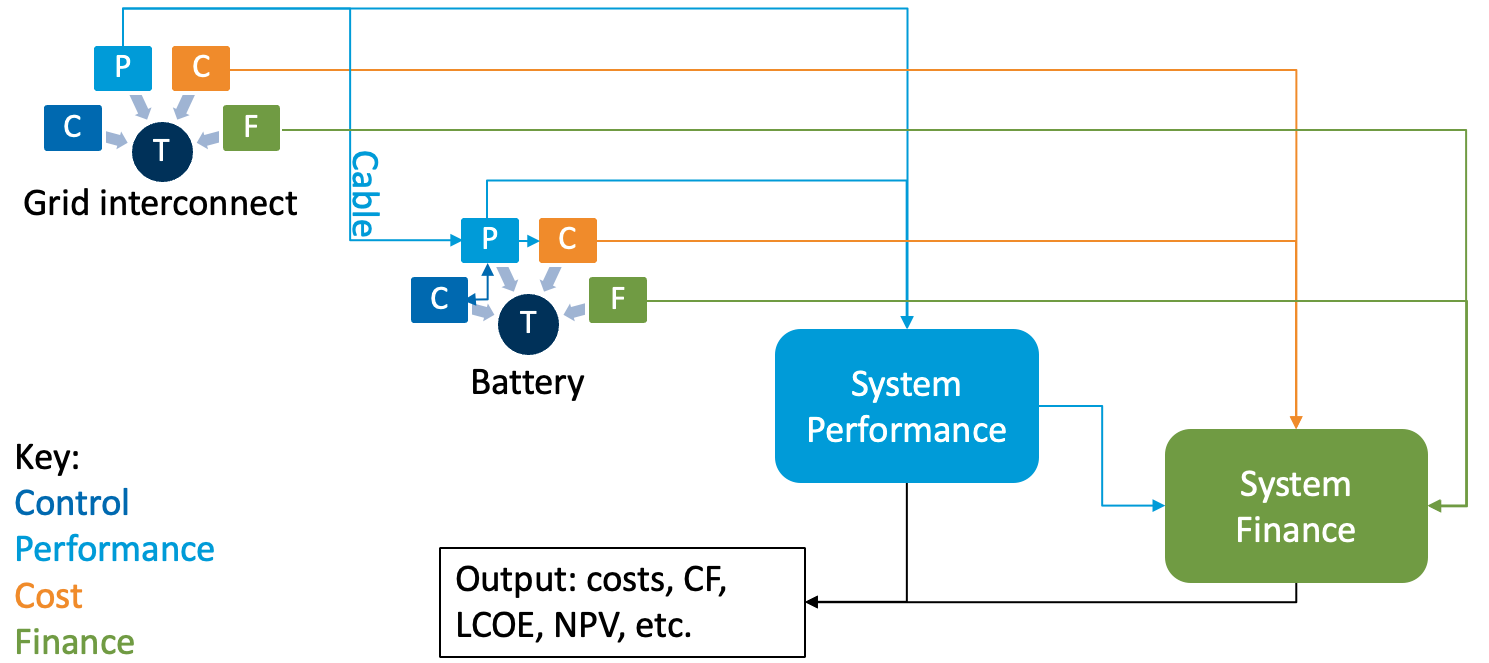
If technologies require resource or price profiles, they can be provided by the user, or in many cases pulled automatically from existing databases. The costs and performance of the technology models in the system are combined into system-level performance and finance components for techno-economic analysis of the hybrid system. H2Integrate systems may include multiple system-level finance models to assess results with different system boundaries if desired. Besides simulation and analysis, H2Integrate can also perform system and sub-system optimization.
A more complex and generalized example of an H2Integrate model is shown below:
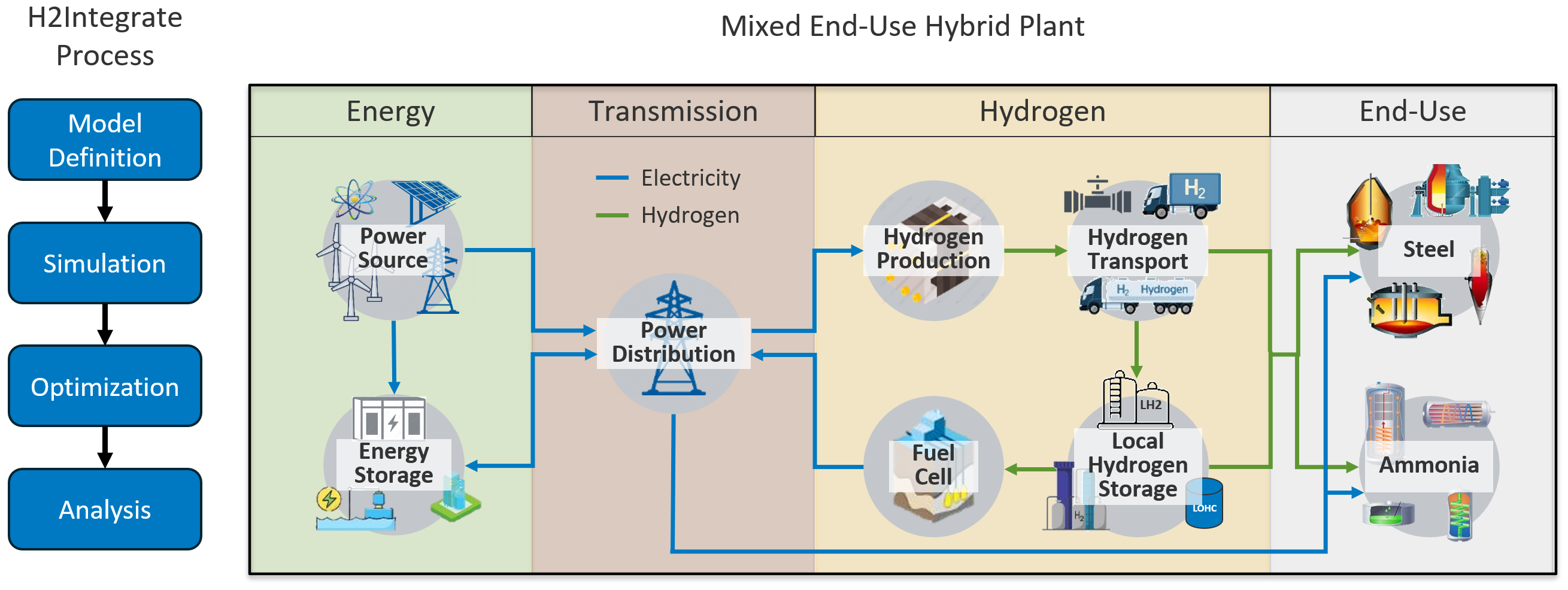
The modular nature of the H2Integrate system makes adding custom models, including proprietary models for local analysis only, very straightforward.
How does H2Integrate differ from other tools?#
H2Integrate is developed at NLR, which has a long history of developing high-quality tools for renewable energy systems. Although there are many tools available for modeling hybrid energy systems, H2Integrate is unique in its focus on component-level modeling and design including nonlinear physics models, as well as its modularity and extensibility. H2Integrate stands out by offering a modular approach that models the entire energy system, from generation to end-use products such as hydrogen, ammonia, methanol, and steel, which is a capability not commonly found in other tools.
REopt is similar to H2Integrate in that it models hybrid energy systems, though it is a higher-level tool that focuses on linear optimization. One significant difference is that REopt can accommodate various external loads such as steel or ammonia, as long as the user provides the load profiles for those end-uses. H2Integrate models the processes themselves and does not require the user to provide a load profile, instead modeling what the load profile would be based on physics-based or analytical models.
SAM is another relevant tool (that H2Integrate partially uses), which gives more detailed performance and financial modeling capabilities than REopt. Like REopt, SAM also does not model loads or end-uses but accepts timeseries data of the loads for design purposes.
H2Integrate goes into more component-level details than those tools, especially in terms of nonlinear physics-based modeling and design.
Note
H2Integrate was previously known as GreenHEART, and some publications or references may refer to it by that name.
Publications#
For more context about H2Integrate and analyses performed using the tool, see the publications below. PDFs are available in the linked titles.
Techno-economic analysis of low-carbon hydrogen production pathways for decarbonizing steel and ammonia production#
Reznicek, E.P., et al. "Techno-economic analysis of low-carbon hydrogen production pathways for decarbonizing steel and ammonia production." Cell Reports Sustainability. Vol. 2. No. 4. Elsevier, 2025.
Nationwide techno-economic analysis of clean hydrogen production powered by a hybrid renewable energy plant for over 50,000 locations in the United States#
Grant, E., et al. "Hybrid power plant design for low-carbon hydrogen in the United States." Journal of Physics: Conference Series. Vol. 2767. No. 8. IOP Publishing, 2024.
Exploring the role of producing low-carbon hydrogen using water electrolysis powered by offshore wind in facilitating the United States' transition to a net-zero emissions economy by 2050#
Brunik, K., et al. "Potential for large-scale deployment of offshore wind-to-hydrogen systems in the United States." Journal of Physics: Conference Series. Vol. 2767. No. 6. IOP Publishing, 2024.
Examining how tightly-coupled gigawatt-scale wind- and solar-sourced H2 depends on the ability to store and deliver otherwise-curtailed H2 during times of shortages#
Breunig, Hanna, et al. "Hydrogen Storage Materials Could Meet Requirements for GW-Scale Seasonal Storage and Green Steel." (2024).
DOE Hydrogen Program review presentation of H2Integrate#
King, J. and Hammond, S. "Integrated Modeling, TEA, and Reference Design for Renewable Hydrogen to Green Steel and Ammonia - GreenHEART" (2024).
Software Citation#
If you use this software in your work, please cite using the following BibTeX:
@software{brunik_2025_17903150,
  author = {Brunik, Kaitlin and
    Grant, Elenya and
    Thomas, Jared and
    Starke, Genevieve M and
    Martin, Jonathan and
    Ramos, Dakota and
    Koleva, Mariya and
    Reznicek, Evan and
    Hammond, Rob and
    Stanislawski, Brooke and
    Kiefer, Charlie and
    Irmas, Cameron and
    Vijayshankar, Sanjana and
    Riccobono, Nicholas and
    Frontin, Cory and
    Clark, Caitlyn and
    Barker, Aaron and
    Gupta, Abhineet and
    Kee, Benjamin (Jamie) and
    King, Jennifer and
    Jasa, John and
    Bay, Christopher},
  title = {H2Integrate: Holistic Hybrids Optimization and Design Tool},
  month = dec,
  year = 2025,
  publisher = {Zenodo},
  version = {0.4.0},
  doi = {10.5281/zenodo.17903150},
  url = {https://doi.org/10.5281/zenodo.17903150},
}
Getting Started
User Guide
- Model Overview
- Technology Models Overview
- How to set up an analysis
- Connecting technologies
- Defining Sites and Connecting Resources
- Design optimization in H2I
- Parameter sweeps in H2I
- Postprocessing results
- Recording and Loading Data From H2I Simulations
- Custom user-defined models
- Running several cases in sequence
- Sizing Modes with Resizeable Converters
- Plotting geospatial data with GeoPandas and Contextily
Technology Models
- Feedstock Models
- Marine Hydrokinetic (MHK) Models
- Run-of-river hydropower model
- Tidal Models
- Natural gas power plant model
- Nuclear power plant models
- WOMBAT Electrolyzer O&M Model
- Solar-PV model using Pvwattsv8 module in PySAM
- Wind Plant model using Windpower module in PySAM
- Solar-PV Cost Models based on ATB-Formatted Cost Data
- Wind Cost Model based on ATB-Formatted Cost Data
- Marine Carbon Dioxide Capture Models
- Methanol model
- Ammonia model
- Ammonia synloop dynamic operating constraints
- Wind Plant - Ard
- Geologic Hydrogen Models
- Grid Performance and Cost Models
- Hydrogen Fuel Cell Model
- Hydrogen Steam Methane Reformer (SMR) Model
- High-Temperature Steam Electrolysis (HTSE) Model
- Iron electrowinning models
- Iron mine model
- Direct Reduced Iron Models
- Steel Electric Arc Furnace Models
- CMU decarbSTEEL Electric Arc Furnace Models
Storage Models
Resource Models
Finance Models
Developer Guide
Miscellaneous Resources
API Reference
- API Documentation
- h2integrate.core
- h2integrate.core.commodity_stream_definitions
- h2integrate.core.dict_utils
- h2integrate.core.dynamics
- h2integrate.core.env_tools
- h2integrate.core.file_utils
- h2integrate.core.h2integrate_model
- h2integrate.core.model_baseclasses
- h2integrate.core.pose_optimization
- h2integrate.core.sites
- h2integrate.core.supported_models
- h2integrate.core.test
- h2integrate.core.utilities
- h2integrate.core.validators
- h2integrate.feedstocks
- h2integrate.converters
- h2integrate.converters.ammonia
- h2integrate.converters.co2
- h2integrate.converters.generic_converter_cost
- h2integrate.converters.grid
- h2integrate.converters.hopp
- h2integrate.converters.hydrogen
- h2integrate.converters.iron
- h2integrate.converters.methanol
- h2integrate.converters.natural_gas
- h2integrate.converters.nitrogen
- h2integrate.converters.nuclear
- h2integrate.converters.solar
- h2integrate.converters.steel
- h2integrate.converters.test
- h2integrate.converters.tools
- h2integrate.converters.water
- h2integrate.converters.water_power
- h2integrate.converters.wind
- h2integrate.control
- h2integrate.finances
- h2integrate.resource
- h2integrate.storage
- h2integrate.transporters
- h2integrate.tools
- h2integrate.demand
- h2integrate.core