Demand Components#
Demand components define rule-based logic for meeting commodity demand profiles without using dynamic system feedback. These components operate independently at each timestep.
This page documents two core demand types:
GenericDemandComponent— meets a fixed demand profile.FlexibleDemandComponent— adjusts demand up or down within flexible bounds.
Demand component inputs and outputs#
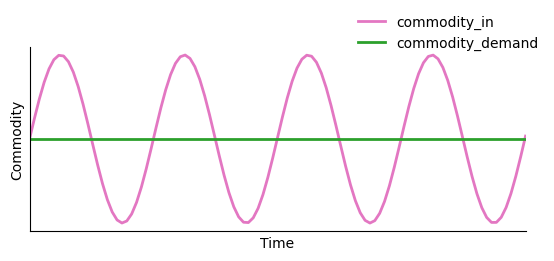
The inputs to the demand components are the {commodity}_demand profile and the {commodity}_in profile. The {commodity}_in profile is the initial commodity used to satisfy the demand. Suppose the {commodity}_in (pink) and {commodity}_demand (green) profiles look like whats shown below:
The demand components then compute the following output profiles:
unmet_{commodity}_demand_out: Unmet demand (non-zero when supply < demand, otherwise 0.)unused_{commodity}_out: Unused commodity (non-zero when supply > demand, otherwise 0.)
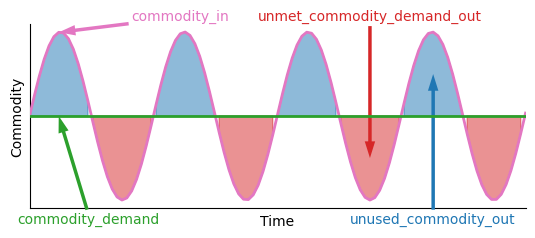
commodity_out: Delivered output (commodity supplied to demand sink)
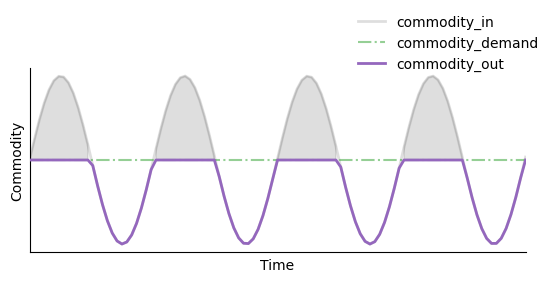
The demand components also compute the following outputs:
capacity_factor: the ratio of the demand that's been met to the full demandrated_commodity_production: the maximum value of the demand profile
Generic Demand Component#
The GenericDemandComponent allocates commodity input to meet a defined demand profile. It does not contain energy storage logic, only instantaneous matching of supply and demand.
The demand component computes each value per timestep:
Unmet demand (non-zero when supply < demand, otherwise 0.)
Unused commodity (non-zero when supply > demand, otherwise 0.)
Delivered output (commodity supplied to demand sink)
This provides a simple baseline for understanding supply–demand balance.
Configuration#
The demand is defined within the tech_config and requires these inputs.
Field |
Type |
Description |
|---|---|---|
|
|
Commodity name (e.g., |
|
|
Units (e.g., |
|
scalar or list |
Timeseries demand or constant demand. |
performance_model:
    model: GenericDemandComponent
model_inputs:
  performance_parameters:
    commodity_name: hydrogen
    commodity_units: kg/h
    demand_profile: [10, 10, 12, 15, 14]
For an example of how to use the GenericDemandComponent framework, see the following:
examples/23_solar_wind_ng_demand
Flexible Demand Component#
The FlexibleDemandComponent extends the generic demand component by allowing the actual demand to flex up or down within defined bounds. This is useful for demand-side management scenarios where:
Processes can defer demand (e.g., flexible industrial loads)
The system requires demand elasticity without dynamic optimization
The component computes:
Flexible demand (clamped within allowable ranges)
Unmet flexible demand
Unused commodity
Delivered output
For an example of how to use the FlexibleDemandComponent demand component, see the following:
examples/23_solar_wind_ng_demand
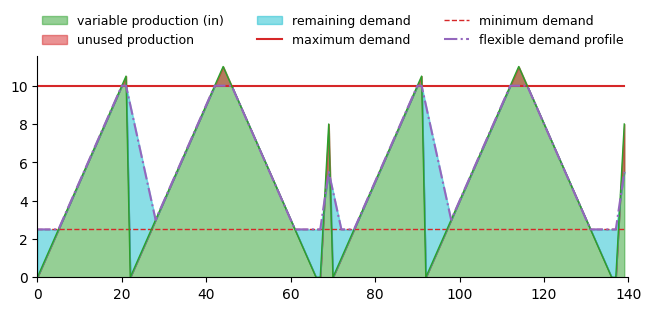
The flexible demand component takes an input commodity production profile, the maximum demand profile, and various constraints (listed below), and creates a "flexible demand profile" that follows the original input commodity production profile while satisfying varying constraint. Please see the figure below for an example of how the flexible demand profile can vary from the original demand profile based on the input commodity production profile and the ramp rates. The axes are unlabeled to allow for generalization to any commodity and unit type.
|
|---|
Configuration#
The flexible demand component is defined within the tech_config with the following parameters:
Field |
Type |
Description |
|---|---|---|
|
|
Commodity name. |
|
|
Units for all values. |
|
scalar or list |
Default (nominal) demand profile. |
|
float |
Minimum fraction of baseline demand allowed. |
|
float |
Maximum ramp-down rate per timestep expressed as a fraction of baseline demand. |
|
float |
Maximum ramp-up rate per timestep expressed as a fraction of baseline demand. |
|
float |
Minimum total fraction of baseline demand that must be met over the entire simulation. |
model_inputs:
  performance_parameters:
    commodity_name: hydrogen
    commodity_units: kg/h
    demand_profile: [10, 12, 10, 8]
    turndown_ratio: 0.1
    ramp_down_rate_fraction: 0.5
    ramp_up_rate_fraction: 0.5
    min_utilization: 0